The Certification Pathway
Upledger Institute International offers two levels of CranioSacral Therapy certification. The Techniques level (CST-T) certifies your foundational CST skills through CS1, CS2, documented sessions, and exams. The Diplomate level (CST-D) builds on that, adding advanced coursework, case histories, a Preceptorship, and a public contribution requirement.
Both levels require you to be a licensed healthcare professional with the legal authority to perform hands-on therapy on clients. This includes physical therapists, occupational therapists, massage therapists (where state law permits), nurses, chiropractors, physicians, dentists, and many other licensed practitioners.
Not ready to commit to full certification yet? You can start with courses in the core curriculum and decide whether to continue through certification later. Most practitioners find the coursework valuable on its own — certification adds formal credentials and IAHP directory listing.
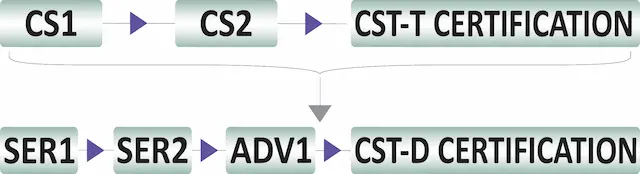
CST and SER Certification Pathway
The Two Certification Levels
CST Techniques Certification (CST-T)
Credential earned: Use of "CST-T" designation
Prerequisite: CranioSacral Therapy 2 (CS2)
Requirements:
- Licensed healthcare professional with authority to treat clients hands-on
- Complete UII CranioSacral Therapy 1 (CS1) and CranioSacral Therapy 2 (CS2)
- Document 75 ten-step protocol sessions
- Pass an essay exam (submitted in advance)
- Pass an objective written exam
- Pass a practical/oral exam evaluating hands-on technique
Cost: $500 (covers one sitting; retaking a failed practical component costs 50% of the certification fee)
The fastest path to CS1 and CS2 is through the Core-Pak, which combines both courses at a reduced price.
CST Diplomate Certification (CST-D)
Credential earned: Use of "CST-D" designation
Prerequisite: Advanced CranioSacral Therapy 1 (ADV1) + all CST-T requirements
Additional requirements beyond CST-T:
- Complete Advanced CranioSacral Therapy 1 (ADV1)
- Pass all Techniques-level requirements
- Pass Diplomate-level essay, objective written, and practical/oral exams
- Submit three case histories
- Complete a Preceptorship (30 contact hours minimum)
- Present a 1 to 4 hour CST presentation to an organized group, or publish an article on CST in a third-party publication
Cost: $500 (additional fees may apply for Preceptorship or testing site location)
Maintaining Your Certification
UII requires each certified therapist to complete 24 continuing education hours every four years. Accepted formats include:
- UII CST courses (as a participant or assistant)
- Mentor programs
- Symposiums
- Research conferences
- Preceptorships
Before renewal, you submit a renewal application and a copy of your current healthcare license or equivalent documentation. UII reserves the right to revoke certification for conduct deemed inappropriate by the certification ethics committee.
Benefits of Getting Certified
- Your name and credential appear in the IAHP.com alumni directory, the global referral source patients use to find qualified CST practitioners
- You are eligible to use the UII Certification logo in your advertising and on business cards
- You stand out among peers as a practitioner who has formally demonstrated their skills through examination
- You affirm your capabilities and give clients confidence in your training
- You contribute to building the legislative and insurance reimbursement case for CST as a recognized therapy
- You have access to the latest research, mentoring opportunities, and the UII practitioner community
Note: CST certification does not serve as a hands-on therapy license. You must maintain your professional license separately.
Frequently Asked Questions
Yes. You must hold a license or certificate that permits you to perform hands-on therapy on clients. Eligible professions include physical therapists, occupational therapists, massage therapists (where state law permits), nurses, chiropractors, physicians, dentists, and other licensed healthcare providers. In states that do not require a hands-on therapy license, you still need documented training in anatomy and physiology (80 hours), pathology (15 hours), and ethics (3 hours). If you lack that coursework, UII offers the Upledger Health Science Essentials program through the London College of Osteopathy to meet those requirements.
You must complete CranioSacral Therapy 1 (CS1) and CranioSacral Therapy 2 (CS2) through Upledger Institute International. The Core-Pak combines both courses at a reduced price and is the recommended starting point for practitioners pursuing certification. Courses run at locations worldwide throughout the year.
75 ten-step protocol sessions, documented and submitted as part of your application. These are sessions where you perform the complete CST ten-step protocol on clients. You can begin accumulating and documenting sessions as you progress through your coursework, so you do not have to wait until all courses are complete before starting this process.
The certification exam has three components:
- Essay exam — submitted in advance and graded before the in-person exams. You receive your passing notification along with instructions for the objective and practical exams.
- Objective written exam — tests your knowledge of anatomy, physiology, and CST principles.
- Practical/oral exam — conducted in person, where examiners evaluate your hands-on technique and your ability to apply CST in a clinical context.
The $500 fee covers one full sitting. If you do not pass a component of the practical exam, retaking that component costs 50% of the certification fee. Testing site location may involve additional fees.
CST-T (Techniques Certification) certifies foundational CST skills. It requires CS1, CS2, 75 documented protocol sessions, and passing three exam components. CST-D (Diplomate Certification) certifies advanced skills. It requires everything the CST-T requires, plus: completion of Advanced CranioSacral Therapy 1 (ADV1), three case histories, a Preceptorship (30 contact hours minimum), and a public contribution in the form of a presentation or a published article. Both cost $500. Both earn a formal UII credential and an IAHP directory listing.
Most practitioners take one to three years from CS1 through certification, depending on how frequently they attend courses and how quickly they accumulate documented sessions. UII and its international affiliates offer courses throughout the year at locations worldwide. The pacing is largely self-directed — you progress as your schedule and client load allow. Some practitioners move through the sequence faster; others take longer while building their practice alongside their studies.
You can attend UII courses before you hold a healthcare license. Some students begin coursework while completing a licensure program. You cannot apply for certification, however, until you hold the required license or certificate. Starting courses early gives you a head start on both your training and your session documentation once you are licensed.
If you do not complete the required 24 continuing education hours every four years and submit a renewal application with a copy of your current healthcare license, your certified status lapses. UII maintains the right to revoke certification for ethics violations as well. If your certification lapses, contact UII directly to discuss reinstatement options.
Yes. Upledger Institute International has more than 70 international affiliates. Certified practitioners — both CST-T and CST-D — appear in the IAHP.com directory, which patients worldwide use to find qualified CST practitioners. Courses are offered internationally through UII's affiliate network, so practitioners in many countries can complete their training locally and earn the same UII certification credential.
Call UII at 1-561-622-4334, ext. 2, or toll-free at 1-800-233-5880, ext. 2. You can also register online through the UII shop. Core-Pak participants complete the Applicant Data Form directly — see the CST-T details page for the form links.
A Preceptorship is 30 minimum contact hours of supervised clinical work. Accepted formats include: supporting a therapist in an Intensive Program, precepting an Advanced class, or attending a Clinical Application of SER or Clinical Application of Advanced CST class. The Preceptorship gives you supervised, advanced clinical experience that goes beyond what coursework alone provides. Fees may vary depending on location and format.
Your name and credential designation appear in the IAHP.com directory (International Association of Healthcare Practitioners), the global referral platform patients use to find qualified CST practitioners. Your listing will show your certification level and location, helping patients in your area find you. This visibility is one of the practical advantages of completing the certification process beyond the training itself.
Become Certified
Ready to learn about becoming a certified CST practitioner?
Contact Us
Have questions?